Every rooftop tent spec sheet has a fabric section, and every fabric section is written in a dialect of numbers: 600D, 280 g/m², 3,000 mm waterproof, UV-treated, CPAI-84. Most of those numbers are real measurements. The problem is that they measure different things, and almost none of them mean what a buyer assumes they mean. This article is the version you would get if you asked a tent factory what the numbers actually track: what a denier is, what a hydrostatic head test physically does to a piece of fabric, where canvas and coated polyester genuinely differ, and which lines on a spec sheet deserve scrutiny.
Fabric is the component a rooftop tent owner interacts with every single trip. The shell opens and closes; the fabric is what you touch, what blocks the rain, what breathes or doesn’t, and what quietly ages in a garage between seasons. It is also the component where marketing language and engineering reality drift furthest apart — so it is worth grounding the vocabulary first.
The two fabric families in a rooftop tent spec sheet
Almost every rooftop tent uses one or both of two fabric families, and the choice is not aesthetic — it is a division of labour:
- Poly-cotton canvas. A woven blend, typically around 65% polyester and 35% cotton in rooftop tent weights of roughly 230–320 g/m². It is the body-wall fabric in canvas rooftop tents: heavy, dimensionally stable, quiet in wind, and hygroscopic — it absorbs and releases water vapour.
- Coated woven polyester (often called Oxford). A synthetic weave — 210D, 420D, 600D are common yarn callouts — with a polyurethane (PU) or PVC coating on the underside that provides the waterproofing. It is the standard rainfly and the standard shell fabric on soft-shell tents where every kilogram matters.
The distinction matters because the two materials fail differently, age differently, and need different care. A canvas wall that is “leaking” is usually a wicking or seam problem; a coated flysheet that is “leaking” is usually a coating that has reached the end of its chemical life. Treating them as interchangeable — as most “which is better” listicles do — produces wrong conclusions for both. The split also maps onto the shell debate: a hard-shell tent mostly hides its fabric behind an aluminium or ABS lid, while a soft-shell tent is its fabric structure, which is why material quality dominates the long-term outcome in that comparison — see our honest hard-shell versus soft-shell comparison.
| Property | Poly-cotton canvas (body walls) | PU-coated polyester (rainfly / shell) |
|---|---|---|
| Waterproofing mechanism | Mass of fibre plus tight weave; water-resistant rather than waterproof at the face, relies on an outer fly in sustained rain | The coating — the base weave alone is not waterproof |
| Moisture behaviour | Absorbs and releases vapour; buffers interior humidity | Blocks water in both directions; humidity control depends on ventilation |
| Noise in wind | Low; the fabric drapes and self-damps | Higher; coated synthetics can drum and crackle until tension settles |
| Typical failure mode | Mould from improper storage, cotton-fibre UV degradation over years | PU coating hydrolysis and delamination with age, not sudden wear |
| Weight | Heavier per covered area | Lighter; why it dominates flysheets and travel-focused shells |
| Best role | Living-space walls: breathability, insulation support, acoustics | Rain defence: flysheet, roof cover, door and window storm flaps |
Denier and GSM: two rulers that measure different things
This is the most common point of confusion on a spec sheet, so it is worth being precise.
Denier (D) is a property of the yarn, not the cloth: it is the weight in grams of 9,000 metres of that yarn. A “600D” polyester yarn therefore weighs 600 g per 9 km. Denier tells you how thick the individual threads are. It says nothing about how tightly they are woven, how many there are per centimetre, or what coating is applied afterwards.
GSM (grams per square metre) is a property of the finished fabric — yarn, weave, and coating together. Two fabrics can both use 600D yarn and differ by well over 50 g/m² because one has a denser weave or a heavier PU coating.
The practical consequence: denier without GSM is a half-specification. A buyer comparing “600D” against “420D” is comparing yarn thickness while remaining blind to weave density and coating weight, which drive abrasion life and waterproofness far more than the yarn number does. When we write fabric into a purchase order at the factory, the line reads something like “600D polyester Oxford, PU-coated, ≥280 g/m² finished, hydrostatic head per ISO 811” — because every clause carries information that “600D” alone does not.
| Spec-sheet term | What it physically measures | What it does not tell you |
|---|---|---|
| 600D / 420D / 210D | Yarn linear mass (g per 9,000 m of yarn) | Weave density, coating weight, finished fabric weight, durability |
| 230–320 g/m² (canvas) | Finished fabric areal weight | The poly/cotton ratio unless stated; weave tightness |
| “3000 mm waterproof” | Hydrostatic head of the fabric plus coating, factory-new (ISO 811 method) | Seam and stitch waterproofing, coating age behaviour, fabric life |
| “UV-treated” | Usually a UV-stabiliser additive in the fibre or coating | Any quantified result — a real claim cites hours under a test lamp and residual strength |
| CPAI-84 | US flammability pass for tent fabrics | Everything except flammability |
Hydrostatic head: what the waterproof number physically describes
The “mm” figure is one of the few spec values with a standardised physical test behind it. In the ISO 811 method, a circle of fabric is clamped under a water column and the pressure is raised until water penetrates in defined spots; the column height at that moment, in millimetres, is the hydrostatic head. A “3,000 mm” fabric held back a three-metre column of water in the lab, on the day it was made.
That last clause is where honest interpretation starts, because the number describes three things and only one of them is your tent:
- It describes the fabric, not the tent. Stitching punches thousands of holes through a coated fabric. Seam sealing or taping is what restores waterproofness along those lines, and seam quality is a separate specification from hydrostatic head. A 5,000 mm flysheet with poorly taped seams will leak before a 2,500 mm one with good tape.
- It describes the coating on the day it was tested. PU coatings age by hydrolysis — the polymer slowly reacts with moisture in the air, stiffens, and can eventually flake off. Heat and humidity accelerate it, which is why a tent stored damp in a hot garage ages its coating far faster than one dried and stored loosely. The rating on the box is a beginning-of-life value.
- It is a benchmark, not a linear quality scale. Commonly used reference points in outdoor fabric specs give the scale meaning: around 800 mm is light-shower territory, 1,500 mm is the threshold most specs treat as waterproof fabric, 3,000 mm is a sensible spec for a flysheet facing wind-driven rain, and 5,000 mm claims belong to storm-grade, taped constructions. Going from 3,000 to 5,000 mm on vertical walls buys little, and usually costs coating stiffness and weight.
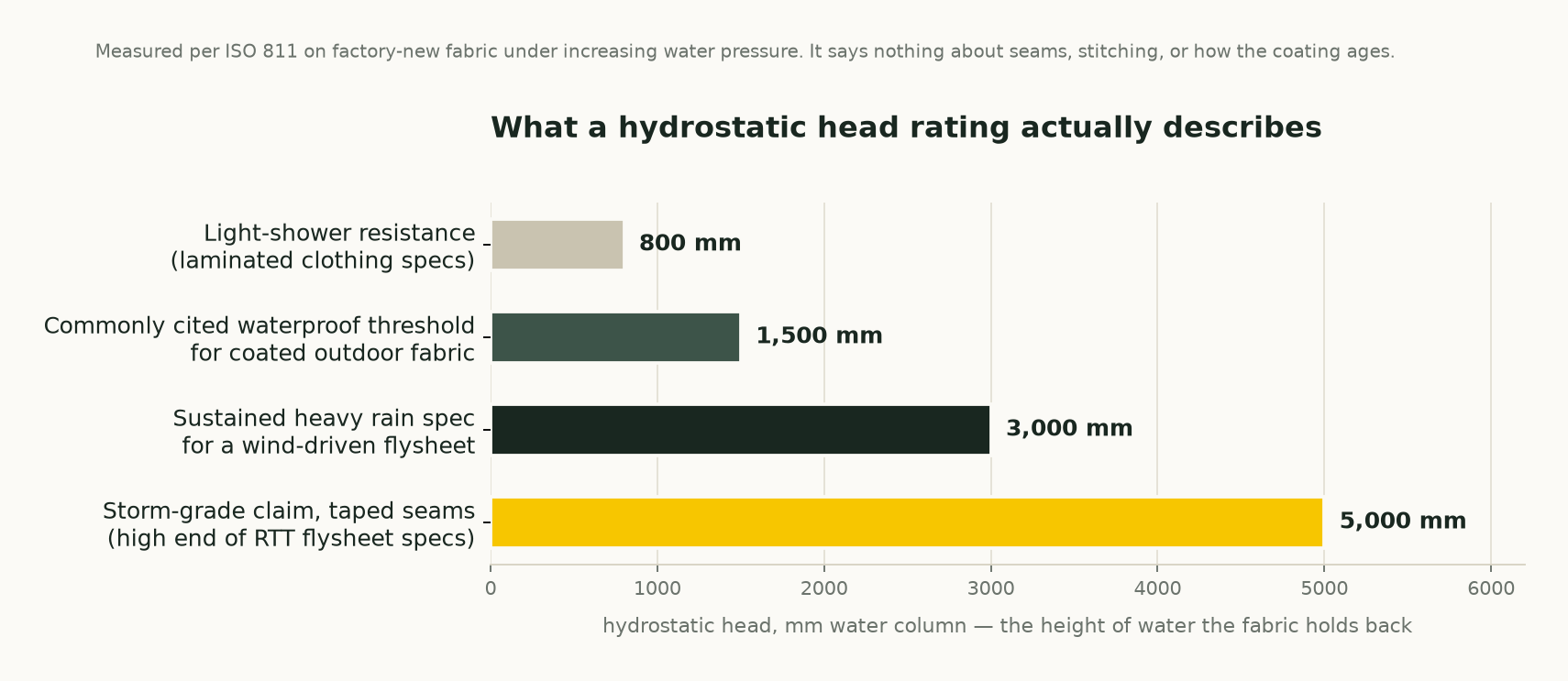
The scale behind the numbers. Note what the test does not cover: seams, stitching, abrasion of the coating, and ageing.
One more factory-floor note: hydrostatic head is measured on the coated side under pressure. Face fabric that wets out quickly is normal and cosmetic — the outer face of a coated flysheet saturating in rain does not mean water is passing through. Owners judging “my flysheet is leaking” from a wet-looking surface are usually observing this wicking on the face, not penetration.
UV: the quiet variable nobody quantifies
Ultraviolet exposure breaks polymer chains. That single sentence explains most long-term fabric behaviour. What it means for the two families differs:
- Polyester (PET) is one of the more UV-stable common fibres. It loses strength slowly and predictably, which is a major reason it dominates flysheets and awnings that live outside.
- Cotton degrades measurably faster under UV than polyester, which is one argument for the synthetic share of a poly-cotton blend: the polyester carries the structural load, the cotton contributes feel and moisture buffering.
- Colour fading and strength loss are different phenomena. A faded flysheet is not necessarily weak, and a colourfast one is not necessarily strong — they are tested separately (lightfastness standards such as the ISO 105 series versus residual tensile strength). Judging fabric health by colour is unreliable in both directions.
Because UV damage is cumulative and dose-driven, the practical levers are simple: use the included travel cover when the tent is on the vehicle between camps, park with the flysheet side out of permanent afternoon sun where possible, and treat a decade-old cotton-rich canvas as a fabric approaching the end of its fibre life even if it “looks fine”.
Breathability: the trade-off spec sheets skip entirely
Here is the honest sentence most marketing will not print: a fully waterproof coated fabric is also fully vapour-proof. The same coating that stops rain stops the roughly one litre of water vapour two sleeping adults exhale overnight. Fabric choice therefore shapes your condensation risk more than any accessory.
- Canvas walls buffer humidity: the hygroscopic fibres absorb vapour when the interior is humid and release it when the air dries, flattening the peaks that drive condensation. The cost is weight, slower drying, and a storage discipline — damp canvas grows mould, which we have covered in detail in our canvas care and mould guide.
- Coated polyester walls do not buffer anything. They are excellent at their job — water stays out — and demand working ventilation in exchange, because every gram of vapour you produce has to leave through an airflow path, not through the wall. This is why vent placement and mesh panel area deserve as much attention as fabric specs when comparing tents, a mechanism we unpacked in our condensation article.
Neither behaviour is a defect; they are a matched pair of engineering trade-offs. The mistake is buying a sealed synthetic shell and then sealing every vent for winter — a combination that manufactures condensation no fabric can rescue. The fabric-ventilation interaction also changes in cold weather, which is one of the reasons four-season design is harder than adding insulation, as our insulation breakdown shows.
Coatings and the small print: where the real specification lives
On a coated polyester, the coating is the waterproof layer, so its type and condition matter more than the denier print. The usual options:
| Coating / treatment | What it does | How it ages |
|---|---|---|
| PU (polyurethane) coating | Standard waterproof layer on flysheets; hydrostatic head lives here | Hydrolyses over years; faster in heat and humidity; becomes stiff, then can delaminate |
| PVC coating | Heavier, very waterproof, cheap; common on budget ground tarps | Plasticiser loss makes it brittle in cold; adds significant weight |
| DWR (durable water repellent) | Top-face finish that makes water bead and the face fabric shed | Wears with abrasion and dirt; revives with re-proofing and heat activation |
| Anti-mildew treatment | Slows microbial growth on cotton-rich canvas during storage | A delay, not an exemption — dried, ventilated storage is still the real defence |
| Flame-retardant treatment | CPAI-84 compliance for the US market | Stable; relevant to import compliance, not performance |
Two practical notes from the production side. First, taped seams are a coating-dependent process: seam tape bonds to PU well, which is why most quality flysheets are taped, while heavy PVC and some canvas constructions use different sealing approaches. Second, a DWR-degraded flysheet is not a failed flysheet — beading on the face is a maintenance state, not the waterproof barrier. Washing the dirt off and re-proofing restores it, the same maintenance chain described in the canvas care guide.
Where the fabric weight lands on the roof
Fabric is one of the quietly large line items in a rooftop tent’s mass budget. A canvas-bodied tent can carry several kilograms more fabric than an equivalent-specified synthetic one, before counting the additional frame needed to tension it. That is not an argument against canvas — it is an argument for knowing where your kilograms sit, because payload is spent once and spent everywhere. We did the full component-by-component accounting in our rooftop tent weight breakdown, and fabric choice is one of the three decisions that move the total most.
The interaction runs the other way too: roof load limits constrain fabric ambition. A vehicle with a low dynamic roof rating pushes the design toward coated polyester walls and a lighter flysheet, trading some of the canvas advantages above — which is exactly the kind of trade a buyer should see written down rather than hidden behind the word “premium”.
How a factory actually tests fabric before it becomes a tent
Fabric arrives at a tent factory as rolls, and the honest version of quality control happens before anything is cut. The checks that matter, in the order we run them:
- GSM per batch. A cut sample is weighed to verify finished fabric weight against the purchase order — the single fastest check that the mill shipped what was agreed.
- Hydrostatic head per ISO 811 on samples from the batch, not from the sales brochure.
- Spray rating (e.g. ISO 4920) to verify face-fabric water shedding on DWR finishes.
- Colourfastness to light and rubbing (ISO 105 series) — the spec that predicts how the fabric looks after two seasons, not just how it photographs on day one.
- Seam slippage and stitch integrity on the finished panel combinations, because two individually excellent fabrics can produce a weak joint.
This is the same incoming-inspection discipline described in our pre-shipment QC checklist, viewed from the fabric side. The reason to describe it here is not self-congratulation; it is that every test above maps to a question a wholesale buyer can and should ask any supplier, including us.
Reading a fabric spec sheet honestly: red flags and good signs
Stripped of brand noise, a trustworthy fabric specification is transparent about method and condition. The pattern is consistent:
| Spec-sheet signal | What it suggests |
|---|---|
| “600D” with no GSM, no coating type | A half-specification — ask for finished weight and coating before comparing |
| “5000 mm waterproof” with no test standard | An unanchored claim; real ratings cite ISO 811 or an equivalent method |
| “Waterproof” describing a canvas wall | Wording drift — canvas is water-resistant; the fly does the waterproofing |
| “UV-resistant” with no test basis | Unverifiable; a serious claim cites hours under a standard lamp and residual strength |
| Hydrostatic head + standard + taped-seam spec, stated separately | The signs of a spec written by someone who has sat through a leak test |
If you are evaluating suppliers rather than tents, the five questions that cut through are: What is the finished GSM of each fabric panel? What test standard and value does the hydrostatic head cite? Which panels are seam-taped? What is the poly/cotton ratio? What does the UV claim rest on? A factory that answers those five in one email has a fabric programme; one that answers in adjectives has a brochure. If you are sourcing rooftop tents or canvases for your own brand and want those answers written into the purchase order instead of the brochure, that is the conversation our OEM/ODM programme exists for.
Frequently asked questions
Is a higher hydrostatic head always better?
No. Beyond roughly 2,000–3,000 mm on vertical walls, additional rating mostly adds coating weight and stiffness while doing nothing about seams or ageing. Spend scrutiny on seam taping and coating quality instead of chasing the biggest number on the page.
Does 600D polyester outlast canvas?
They age on different clocks. Polyester’s weak point is the coating — hydrolysis sets a chemical shelf life regardless of how careful you are. Canvas’s weak points are mould and cotton-fibre UV degradation, both of which respond to storage discipline. A neglected canvas tent can die young; a well-stored one can outlast several coated flysheets.
My flysheet face wets out in rain — is it leaking?
Almost certainly not. Face wetting is the outer fabric saturating while the coating still holds; penetration shows on the underside. If the face no longer beads, clean and re-proof it — that is maintenance, not failure.
What canvas weight makes sense for frequent use?
Heavier canvas (towards 320 g/m²) buys wind stability, acoustic damping and a meaningful contribution to thermal comfort, at a real cost in roof payload and drying time. Lighter blends suit travel-heavy use. The right answer depends on your vehicle’s roof load budget as much as on the fabric itself. A 600D polyester-cotton body on an aluminium shell — the combination used in our RTT-12 roof top tent — is the heavier end of that trade-off.
Fabric is not the glamorous component in a rooftop tent, but it is the one doing full-time work in every season you own the tent. Read its numbers the way the test methods read them — as measurements with conditions — and both marketing claims and genuine differences become much easier to separate. More factory-side breakdowns, from shell construction to quality control, live in our roof top tents library.