Every rooftop tent weight figure on a spec sheet is the end of a design process, not the start of one. Two tents can both claim 68 kg and behave completely differently on a roof, because weight is not one number — it is a budget split between shell, frame, foam, fabric and hardware. This is how that budget is actually spent, measured on the tents we build.
So how much does a rooftop tent weigh? The honest answer is a range: roughly 45 kg for a stripped-back wedge to more than 100 kg for a full aluminium box. The range is not the useful part. Where the kilograms sit is, because that decides whether a tent flexes under a knee, leaks at the seal, rattles at 100 km/h, or survives ten seasons of UV.
Rooftop tent weight by type
These are net weights — tent, mattress, ladder and mounting hardware, no carton. The figures on the right are from our own 2026 range, weighed on a floor scale at the factory rather than copied from a brochure.
| Type | Typical net weight | Example from our range |
|---|---|---|
| Soft shell fold-out, 2.4 × 1.4 m | 52–60 kg | RTT-2 — 57 kg |
| Soft shell fold-out, 2.4 × 1.6 m | 58–66 kg | RTT-16A — 65 kg |
| Aluminium hard shell, wedge | 62–72 kg | RTT-12 — 68 kg |
| Aluminium hard shell, pop-up | 75–88 kg | RTT-11-A130 — 80 kg |
| Aluminium hard shell, box | 90–105 kg | RTT-10-A — 98 kg |
| ABS / composite hard shell, 2.2 × 1.6 m | 72–82 kg | RTT-ABS160-H — 74.9 kg |
Read a rooftop tent weight table as a map of structure, not of quality. The 98 kg box is not “30 kg better” than the 68 kg wedge. It has a taller shell, a full perimeter frame instead of two side rails, and a roof that carries its own load. You are looking at how much aluminium is doing structural work.
A weight budget, part by part
Here is the same question asked the way a factory asks it: two builds, ten components, one column each. Every line is a decision someone made — gauge, density, alloy, or “we can save 2 kg here”.
| Component | Aluminium hard shell 2.1 × 1.3 m |
Soft shell fold-out 2.4 × 1.4 m |
|---|---|---|
| Upper shell, 1.5 mm 5052-H32 + closed-cell insulation | 11.4 kg | — |
| Lower base, 15 mm bonded aluminium sandwich | 14.2 kg | — |
| Base deck, 9 mm plywood on aluminium perimeter frame | — | 21.5 kg |
| Frame: 6063-T5 extrusion, corner castings, hoop poles | 12.0 kg | 5.8 kg |
| Hinge, gas struts, latches, straps | 4.6 kg | 1.6 kg |
| Fabric 280 g/m², mesh, zips, window panels | 3.7 kg | 4.1 kg |
| Mattress, 60 mm 25D foam + removable cover | 4.9 kg | 5.2 kg |
| Ladder, 2.3 m telescopic aluminium | 3.4 kg | 3.4 kg |
| Seals, bolts, mounting plates, pockets, hardware | 6.4 kg | 5.0 kg |
| Roof rails, T-slot, crossbars / PVC skirt and base bucket | 6.6 kg | 4.2 kg |
| Travel cover, 600D PVC | — | 5.4 kg |
| LED strip, wiring, USB panel / seals, zips, mesh | 0.8 kg | 0.8 kg |
| Net weight | 68.0 kg | 57.0 kg |
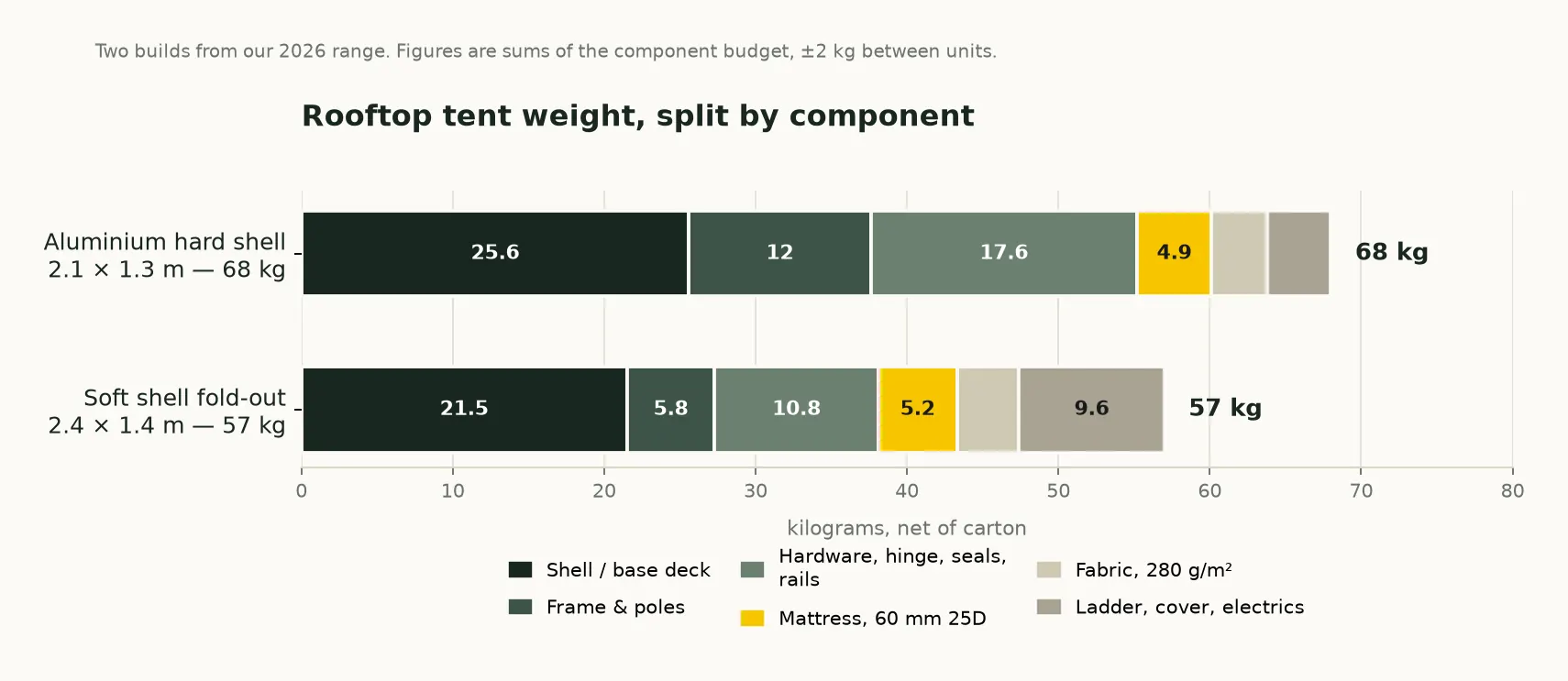
Two ratios come out of that table and they explain most of the arguments in this category.
- The structure is the tent. On the hard shell, panels and frame are 37.6 kg of 68 — 55% of the total before a single soft item is added. On the soft shell, the base deck alone is 21.5 kg, 38% of net weight.
- Fabric is almost irrelevant to weight. It is 5.4% of the hard shell and 7.2% of the soft shell. Anyone selling you a tent on the grounds that it is light “because of the canvas” is either guessing or selling something else.
The shell: where one millimetre decides everything
A flat panel’s resistance to bending scales with the cube of its thickness. Not linearly — cubed. That single relationship explains why lightweight hard shells are hard to build and why cheap ones flex.
| Gauge (5052) | Mass per m² | Mass of a 2.1 × 1.3 m lid | Relative bending stiffness |
|---|---|---|---|
| 1.2 mm | 3.22 kg | 8.8 kg | 1.00 |
| 1.5 mm | 4.02 kg | 11.0 kg | 1.95 |
| 2.0 mm | 5.36 kg | 14.6 kg | 4.63 |
| 2.5 mm | 6.70 kg | 18.3 kg | 9.04 |
Going from 1.2 mm to 1.5 mm adds 2.2 kg to the lid and nearly doubles its stiffness. Going to 2.0 mm adds another 3.6 kg for 2.4 times. On a 2.1 m lid that people kneel on while closing, that trade is worth making. On a 1.4 m wedge it usually is not, which is exactly why the lightest hard shells in the market are short ones. Weight claims and size claims are never independent, even when the marketing treats them that way.
Thickness is only half of it. The alloy decides how the panel behaves when it is hit:
| Alloy / temper | Tensile | Yield | Where it belongs |
|---|---|---|---|
| 5052-H32 | ≈228 MPa | ≈193 MPa | Formed and welded shell panels; best marine corrosion resistance of the three |
| 6061-T6 | ≈310 MPa | ≈276 MPa | Machined parts and brackets where strength per volume matters |
| 6063-T5 | ≈186 MPa | ≈145 MPa | Extruded frames, rails and T-slots; anodises cleanly |
6061-T6 is stronger on paper, and that is where the paper argument ends. Weld it and the heat-affected zone loses a large share of that strength unless the part is re-heat-treated, which almost nobody does on a tent shell. 5052-H32 is weaker but keeps its ductility, so a branch strike dents a panel instead of cracking a seam. A dented lid still seals. A cracked one does not.
Surface treatment is the other half of durability, and it is where budgets quietly get cut. Type II sulphuric anodising runs 10–25 µm; hard anodising (Type III) runs 25–50 µm. Ask for the salt-spray hours to ASTM B117 rather than the word “anodised” — for coastal markets, a few hundred hours of neutral salt spray is a different product from a decorative film.
The base carries more than the mattress
On a fold-out soft shell, the base is the largest single item in the budget and the one buyers inspect least. A 9 mm plywood deck over an aluminium perimeter frame lands around 21 kg for a 2.4 × 1.4 m footprint. A bonded 15 mm aluminium sandwich of similar panel area comes in near 14 kg with better stiffness per kilo — but it costs more, and the bonding process is where a cheap factory loses the argument.
Where base construction shows up: hinge screws pulling out after two seasons, delamination around the ladder hook, and a floor that “oil-cans” when you crawl in at night. None of that is visible in a showroom, and all of it is decided by a few kilograms of material.
The mattress is not a detail
Foam weight is density × volume, and both numbers are negotiable in a quotation:
- 60 mm of 25D foam over 2.73 m² — 4.1 kg. This is the sensible default.
- 60 mm of 30D — 4.9 kg. Firmer, lasts longer, costs about 0.8 kg.
- 80 mm of 25D — 5.5 kg. More comfortable, and it raises the closed shell height.
- 40 mm of 18D — 2.0 kg. This is how a tent loses 2 kg and gains a topper, which then lives in the car at 3 kg.
That last line is the pattern worth remembering: weight removed from the wrong place does not disappear, it relocates into your vehicle.
What the fabric actually costs you
A 2.1 × 1.3 m tent with 1 m walls and a pitched roof uses roughly 9 m² of cloth. At 280 g/m² that is 2.5 kg; at 320 g/m² it is 2.9 kg. The premium for heavier canvas is 0.4 kg. Meanwhile, adding 0.2 mm to both shell panels costs 2.9 kg.
So the fabric decision should be made on waterproofing, breathability and UV life — never on weight. For waterproofing, ask for the hydrostatic head test to ISO 811 and the coating type; “3000 mm” in a brochure with no test report is a number, not a specification.
Net vs gross: the rooftop tent weight your forwarder uses
The number that lands on your invoice is not the one in the brochure. These are real pairs from our packing sheets — net, gross, carton, and the packed volume that air freight prices against at 167 kg/m³.
| Model | Net | Gross | Carton | Packed volume | Air chargeable |
|---|---|---|---|---|---|
| RTT-2 | 57 kg | 58 kg | 1 kg | 0.56 CBM | 94 kg |
| RTT-16A | 65 kg | 66 kg | 1 kg | 0.62 CBM | 104 kg |
| RTT-12 | 68 kg | 74 kg | 6 kg | 0.74 CBM | 124 kg |
| RTT-11-A130 | 80 kg | 91 kg | 11 kg | 0.831 CBM | 139 kg |
| RTT-T05 | 74 kg | 85 kg | 11 kg | 0.438 CBM | 73 kg |
| RTT-10-A | 98 kg | — | — | 0.75 CBM | 125 kg |
In five of these six cases the chargeable weight is set by volume, not by the tent. The compact triangle is the exception: pack it tight enough and actual weight starts to govern. The commercial conclusion is blunt — if your goal is landed cost, cut packed volume before you cut net weight. Ten percent off 0.83 CBM saves more money than eight kilograms off the shell, and it does not touch structural margin.
Why this matters more in 2026 than it did in 2020
Roof ratings are the hard ceiling. Most passenger 4WDs and SUVs are rated for 50–100 kg dynamic load; some utes reach 150 kg. A 68 kg tent, a 25 kg platform and a 20 kg 270° awning is 113 kg before bedding. Moving from a 98 kg box to a 68 kg wedge is often the difference between inside and outside the vehicle’s rating — and no bracket fixes an exceeded roof. The full calculation is in our guide to 4WD roof load ratings.
Electrified vehicles change the arithmetic. Mass costs energy when you accelerate and mostly comes back through regeneration; frontal area costs energy continuously and never comes back. A closed hard shell adds 0.2–0.3 m of height across a 1.3–2.1 m width, which is 0.3–0.6 m² of extra frontal area, and drag rises with the square of speed. Owner-reported highway range losses of 10–20% on electric vehicles are consistent with that frontal-area penalty. Sixty-eight kilograms against a 2,300 kg vehicle is a rounding error next to it — so on an EV, the shell’s shape and the height of the rack matter more than its mass.
One person has to fit it. General manual-handling guidance puts a comfortable two-person lift at about 25 kg each. A 57 kg soft shell is a two-person job off the rack; so is a 68 kg wedge. What changes the experience is not the total so much as the handholds, the balance point, and whether the shell can be tilted on its own hinge. Weight that is badly distributed feels 20 kg heavier than it is.
Buyers now ask for a number before they ask for a feature. In the briefs that reach our quoting desk, “can you build it under 70 kg” has become as common as “can you add another window”. That is a change in the market, not a coincidence: hard shells are now the default request, and a hard shell that is too heavy for the customer’s roof is a hard shell that does not sell.
Six ways weight gets added after the brochure
- The ladder. Usually 3.2–3.6 kg. Sometimes quoted outside the net figure, sometimes not included at all.
- Annex and walls. 4–8 kg, and they live on the tent once fitted.
- Bedding left inside. 4–8 kg. Convenient, and it counts against the roof.
- Condensation mat. 0.8–1.2 kg. Buy it anyway; it prevents the mattress soaking from below.
- Gear bolted to the same rack. Recovery boards and a shovel bracket are 5–10 kg that never appear in a tent review.
- Water. Poly-cotton can take on several percent of its dry mass in a wet pack-down. A 4 kg canvas holding 6% is 240 g — trivial on its own, and the reason a “dry weight” is only true once.
What to write into a purchase order
If you are buying containers rather than one tent, a rooftop tent weight figure belongs in the contract with a tolerance, a scope and a construction spec behind it. Ten lines that prevent most disputes:
| Specify | Ask for | Why it matters |
|---|---|---|
| Net weight per unit | ±2%, average of three units, without carton | A tolerance is the only thing that makes a weight claim enforceable |
| Scope of the net figure | Ladder, mattress, hardware, annex — included or not | A ladder and hardware can be 8% of a 57 kg tent |
| Gross weight, carton dimensions, CBM | All three, per model | Freight is quoted off these, not off net weight |
| Alloy, temper, gauge | e.g. 5052-H32, 1.5 mm ±0.05 | Gauge is where weight is actually decided |
| Base construction | Plywood grade and thickness, or sandwich type | 20–38% of net weight sits here |
| Foam | Density (25D/30D) and thickness | Cheap foam saves 1 kg and costs a mattress topper |
| Fabric | gsm, weave, coating, hydrostatic head with ISO 811 report | Fabric is under 8% of weight — never trade durability for it |
| Hardware | A2/304 stainless, M8 8.8, nyloc nuts | Six kilos of hardware is where corrosion starts |
| Test protocol | Open/close cycles, salt-spray hours, rain test duration | Weight taken out of structure shows up later as fatigue |
| Third-unit check | Weight of unit 3 from production, not the sample | Samples are always lighter than the run |
How to check a weight claim in ten minutes
- Weigh it yourself. Stand on a bathroom scale, then stand on it holding the tent. The difference is accurate to about a kilogram, which is enough.
- Weigh the ladder separately. If it is not in the net figure, add it — then compare like with like.
- Read the carton label and packing list. Shipping documents carry measured numbers, because someone had to pay for them.
- Ask for three consecutive units. One number is a sample; three is a process.
- Ask what was removed to hit the number. Thinner panel, lower-density foam, no condensation mat, steel instead of stainless. There is no wrong answer to this question — only an evasive one.
A rooftop tent weight claim you cannot verify is a marketing number. The verifiable version is a construction spec with a gauge, an alloy, a density and a tolerance attached — and that is what we publish for every model in our roof top tent range, down to net and gross on the packing sheet.
For brand owners and importers, the useful starting point is not a catalogue weight but your own roof rating: tell us the vehicle, the rack and the target weight, and the OEM team will work backwards through gauge, base and mattress to a build that fits. That conversation starts on our OEM/ODM page, and the checks that keep a repeat order consistent are in our If low weight is the priority, the superlight triangle roof top tent is the lightest build we ship, and the numbers on that page are weighed, not estimated.
Related guides: Hard shell vs soft shell roof top tents — what the two constructions actually cost you in use, and how much roof load your 4WD can really take — the dynamic rating, bar spacing and torque numbers behind the ceiling.