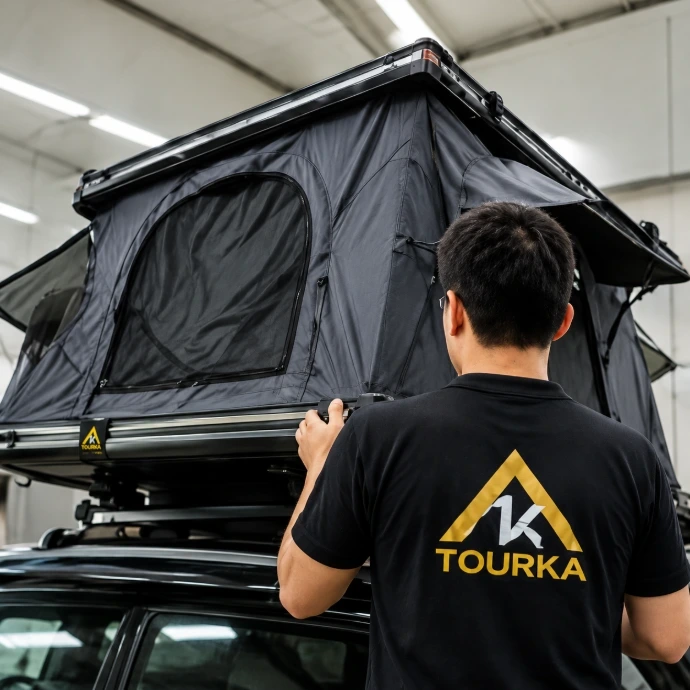
Rooftop tent insulation is the most inconsistently used phrase in the category. Some brands attach it to a quilted liner that clips inside the canvas; others mean a layer of foam glued inside a hard shell; a few use it for any tent that has not visibly collapsed in a snow photo. This article is the version a factory would give you: what actually loses heat two metres off the ground, which materials do the work, where the weight goes, and what a buyer should write into a 4-season purchase order so the claim means something.
Sleeping on the roof changes the physics before it changes the comfort. A rooftop tent does not sit on insulating ground; it sits on a metal rack bolted to a vehicle, in the layer of air where wind is strongest. None of that makes a rooftop tent a bad winter shelter — off the ground is genuinely warmer than on it in wet or snowed-in camps — but it means heat escapes through different paths than people expect, and the fix is rarely “a thicker sleeping bag”.
Rooftop tent insulation: where the heat actually goes
A resting adult releases roughly 100 watts, most of it as heat. In a closed 2 m² sleeping area that is a small electric heater running all night — enough to hold a meaningful temperature difference, provided the tent does not throw it away. Three mechanisms do the throwing, and they rank differently on a roof than on the ground:
- Conduction. Your body presses against a mattress, which sits on a deck, which is bolted to a rack, which is bolted to the vehicle. Every joint in that chain is a thermal bridge if it is metal-to-metal. The floor is the largest continuous conductive path in the tent — and unlike a ground tent, there is no pile of leaves or snow under you to slow it down.
- Convection. Wind strips warm air off any exposed surface. Two metres up, in open terrain, wind runs measurably harder than at ground level, and a moving surface film pulls heat out of thin canvas far faster than still air does.
- Radiation. On a clear night, the sky acts as a heat sink colder than the surrounding air, and the tent’s outer surface radiates to it. That is why a cloudless frost night feels colder inside a thin-walled tent than a cloudy night at the same temperature.
The practical ranking for rooftop tents: the floor dominates when you are parked and the wind is calm; wind and ventilation take over once it blows; radiation matters most through thin fabric on clear nights. Any honest 4-season design addresses all three, in that order of priority.
The floor is the main event
Heat flows downward while you sleep, and the floor is where most tents lose it. Two constructions behave very differently:
| Floor construction | What it is | Thermal behaviour |
|---|---|---|
| Bare plywood deck, 9 mm | Common on entry-level soft shells | Wood is a mediocre insulator; 9 mm conducts a noticeable share of body heat into the base frame, which is aluminium and conducts it away |
| Bonded aluminium sandwich, 15 mm | Hard shell base panel | Structurally excellent, thermally the worst case: two aluminium skins with a core. Without an added insulating layer it is a heat exchanger |
| Sandwich or plywood + bonded closed-cell foam layer | Typical 4-season specification | Closed-cell PE foam at ~10 mm adds real resistance for under a kilogram per square metre and cannot absorb water |
| Foam layer + anti-condensation mat + mattress | Full winter stack | Three resistances in series; the air layers between them do as much work as the materials |
The principle worth internalising: almost nothing insulates by itself. Closed-cell foam, cork, wool and trapped air all work by holding air still. Still air conducts at about 0.026 W/m·K — better than any solid you can buy — so an insulation layer is an air-container, and its thickness matters more than its brand.
Under the mattress, add an anti-condensation mat even in summer. It does not insulate; it ventilates. The mat holds the mattress a few millimetres off the deck so moist air can circulate underneath instead of condensing into the foam base — in winter that is the difference between a dry mattress and one that slowly freezes into a damp block.
The shell: aluminium versus composite, in numbers
This is the decision that most divides a winter range, and it is decided by one material property.

Aluminium conducts heat at roughly 167 W/m·K. ABS conducts at about 0.2. Same area, same temperature difference, the aluminium panel moves heat close to a thousand times faster. That is why an uninsulated aluminium hard shell feels like sleeping in a fridge drawer on a frost night: the shell is not cold because it is thin, it is cold because it is a short circuit.
In practice, both shell types can be built for winter:
- An aluminium shell needs insulation inside it. In our own builds the upper shell is a 1.5 mm 5052 panel lined with closed-cell insulation, which turns the “short circuit” into a layered wall: outer panel, insulation, air gap, inner trim. Done properly, the aluminium becomes a weather skin and the insulation does the thermal work. Done cheaply, the lining is a few millimetres of felt and the marketing says “insulated”.
- An ABS or composite shell starts ahead. The 3–5 mm moulded wall is already a poor conductor, and a double-wall construction adds a still-air cavity. Composite shells also resist dents with elastic rather than plastic deformation, which matters when a cold, brittle situation meets a branch. The trade-offs: composite shells cost more to tool, handle UV differently over a decade, and become impact-brittle at extreme low temperatures depending on the grade — which is exactly the kind of thing a buyer should ask for test data on rather than assume (more on that in the purchase-order section below).
For a full comparison of the two constructions beyond the thermal question, see our hard shell vs soft shell roof top tents guide.
What the canvas does — and does not do
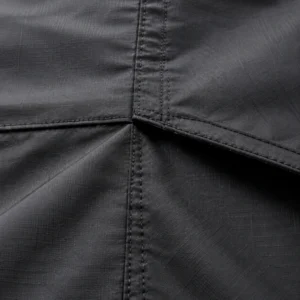
A 280 g/m² poly-cotton canvas wall is windproof, which is most of its winter job. As thermal insulation it is modest: a single woven layer holds maybe R-0.5 to R-1 depending on wind and dampness. Two details change the real-world number:
- Double walls and dead air. Most quality soft shells are effectively two-layer around the sleeping area — canvas plus an inner window/wall panel — and the still air between the layers is doing the insulating. A tent whose inner panel sits flat against the canvas throws that advantage away.
- Dampness. Wet canvas conducts better than dry canvas and loses loft. A tent packed away wet for two days starts the night cold; this is one more reason the drying discipline in our canvas care and mould guide is a winter topic and not just a hygiene one.
Insulation liners: the honest upgrade
A quilted insulation liner — usually polyester batting between two fabric layers, hooking to the tent frame or looping over the poles — is the single most cost-effective winter retrofit for a soft shell. Expect 2–4 kg and a real but bounded effect: the liner mostly stops convective loss and cold radiation through the canvas. It cannot fix an uninsulated floor, and it slightly reduces usable interior volume.
What a liner will not do is fix condensation. In fact, by warming the inner surface it usually reduces condensation on the areas it covers — the classic cold-wall condensation mechanism is covered in detail in our roof top tent condensation guide — but any liner also creates pockets where moist air can stagnate. Buy one that is removable and dryable, and dry it like bedding.
Ventilation: the paradox you cannot skip
Every instinct in winter says seal the tent. The physics says leave the vents cracked open. Two sleeping adults put close to a litre of water into the tent air overnight through breath and perspiration. In a sealed tent that vapour hits the coldest surface available — the shell, the ceiling panel, the underside of a metal base — and condenses. By morning you have a wet tent, wet insulation performs worse, and the cycle compounds night after night.
A small, continuous airflow — vents open, a window mesh exposed — costs far less heat than the moisture it removes. This is not a comfort opinion; it is the same vapour-drive mechanism that causes the condensation problems described in our guide above, and it is why factory 4-season builds spec fixed ventilation rather than relying on users to remember to crack a window.
Heaters: what belongs in a rooftop tent and what does not
Active heat is a legitimate part of a winter setup, but the choice of heater changes the moisture budget of the tent, which then changes the insulation job. The comparison that matters:
| Heater type | Heat delivered | Moisture added | Safety notes | Verdict for roof use |
|---|---|---|---|---|
| Diesel air heater (ducted) | 2–5 kW, dry warm air ducted in from a unit outside | None — combustion happens outside | Exhaust must exit away from the tent and any wind direction | The correct answer for sustained sub-zero use |
| 12 V electric blanket / heated mattress pad | 40–80 W directly into the bed | None | Trivial; run from the vehicle battery per our 12V power sizing guide | Best value-per-watt in the whole winter kit |
| Catalytic propane heater | 1–4 kW radiant | Yes — burning 1 kg of propane releases about 1.6 kg of water vapour | Carbon monoxide risk in a small sealed space; oxygen depletion | Not recommended inside a rooftop tent under any circumstances |
| Hot water bottle / heat packs | Tens of watts, localised | None | None worth noting | Underrated. Pre-warms the bag for the coldest hour of the night |
The propane line deserves emphasis because it surprises people: a heater that burns fuel indoors is also a humidifier. Propane combustion converts hydrocarbon into CO₂ and water vapour at roughly a 1.6:1 mass ratio, so a weekend of “cosy” propane evenings can put more water into a tent than the occupants do by breathing — and that water lands on your cold shell as frost by morning. Dry external combustion (diesel ducted) or no combustion at all (electric) are the only two strategies that do not sabotage your own insulation.
Cold changes the hardware too
Insulation gets the articles, but winter reliability is decided by components:
- Gas struts lose force as temperature drops. Strut force scales with the absolute temperature of the gas: from 20 °C to −10 °C that is about a 10% loss, and cold, thickened damper oil adds drag. A lid that lifts easily in summer can genuinely struggle in January. Specify struts sized with cold-weather margin, not just tuned to pass a showroom demo.
- Coated fabrics stiffen. PVC-coated covers and cheap window films approach their cold-crack range near −20 °C and below; poly-cotton canvas stiffens but recovers. Travel covers and window panels are the first things to crack, not the tent body.
- Water in seals freezes. A tent closed damp can freeze its zip and seal lines shut overnight. Silicone-treated zips and drain paths in the base extrusions are winter features, not luxuries.
- Snow is a load, not a decoration. A closed hard shell sheds dry snow; wet snow accumulates. Snow load counts against the same static limits discussed in our 4WD roof load rating guide — 10 cm of wet snow on a 2 m² lid is roughly 20 kg before you get in.
What to write into a 4-season purchase order
If you are sourcing rather than shopping, “4-season” on a quotation sheet is a claim, not a specification. These ten lines convert it into something a factory can be held to:
| Specify | Ask for | Why it matters |
|---|---|---|
| Shell insulation, defined | Material, thickness, and closed-cell content; bonded or mechanical fit | “Insulated shell” without a thickness is marketing; the layer is 5–15 mm and that range is the product |
| Composite cold-impact rating | Notched impact strength per ISO 179, tested at −30 °C, with the report | Composite shells are not equal at low temperature; the room-temperature value proves nothing about winter |
| Floor insulation | Layer type and thickness between deck and mattress, per model | The floor is the dominant heat-loss path; it is also the cheapest place to spec correctly |
| Mattress | Density (25D/30D), thickness, cover fabric | Foam is also insulation; 60→80 mm helps warmth and raises the shell — know the trade before the PO, not after |
| Insulation liner option | Material, weight, attachment method, packed size | A liner that cannot be removed and dried will create a mould problem, not prevent one |
| Ventilation | Fixed vent area per model, position relative to mattress height | 4-season tents need designed airflow; retrofitted “open a window” advice is not a design |
| Heater provision | Cable pass-through gland and/or duct port, sealable when unused | Retrofitting a hole in a hard shell in the field is how leaks start |
| Fabric | gsm, coating, hydrostatic head with ISO 811 report | Winter asks the canvas to stay supple and waterproof when it is wet and freezing |
| Cold-chamber test | Overnight at −20 °C, logged interior/exterior temperatures, one unit from production | One photograph of a tent in snow is not a test; a temperature log is |
| Struts and hinges | Strut force specified with cold margin; hinge cycle count | Cold failures concentrate at the moving parts, not the panels |
The same discipline that keeps a winter order consistent — measured numbers, test reports, tolerances — is what our roof top tent QC checklist applies to repeat orders generally.
How to sanity-check a 4-season claim in ten minutes
- Look at the floor first. Bare plywood or bare sandwich panel under the mattress with no foam layer means the shell does not matter; the biggest heat path was never addressed.
- Ask what the shell insulation is. Material and thickness. “Insulated” with no number usually means a few millimetres of felt.
- Count the ventilation. A 4-season tent with no fixed vent is a condensation machine at −5 °C, whatever the brochure says.
- Weigh the liner claim. If a liner is optional, ask its weight and attachment. If it is “built in”, ask whether it is removable for drying.
- Ask for the cold test. Chamber log, production unit, one night, two temperature curves. Suppliers who have done it can produce it the same day.
Winter also has a freight and handling angle: insulation adds weight, and every kilogram still counts against the roof. The component-level arithmetic is in our rooftop tent weight breakdown.
Everything above is standard specification work for us. Our roof top tent range lists net weights, shell constructions and packing data per model, and if you are building a branded 4-season line, the OEM/ODM team will quote shell, floor and liner options against your target market’s real winter — not a brochure’s version of it. The ABS shell roof top tent is the hard shell construction described above, with the sandwich floor rather than a board base.
Related guides: Roof top tent condensation: causes and fixes — the moisture side of winter camping, and hard shell vs soft shell constructions — how the two platforms compare beyond the cold.