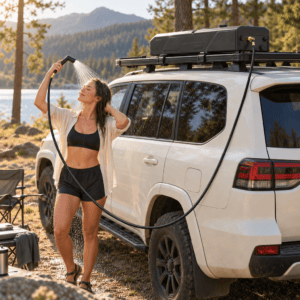
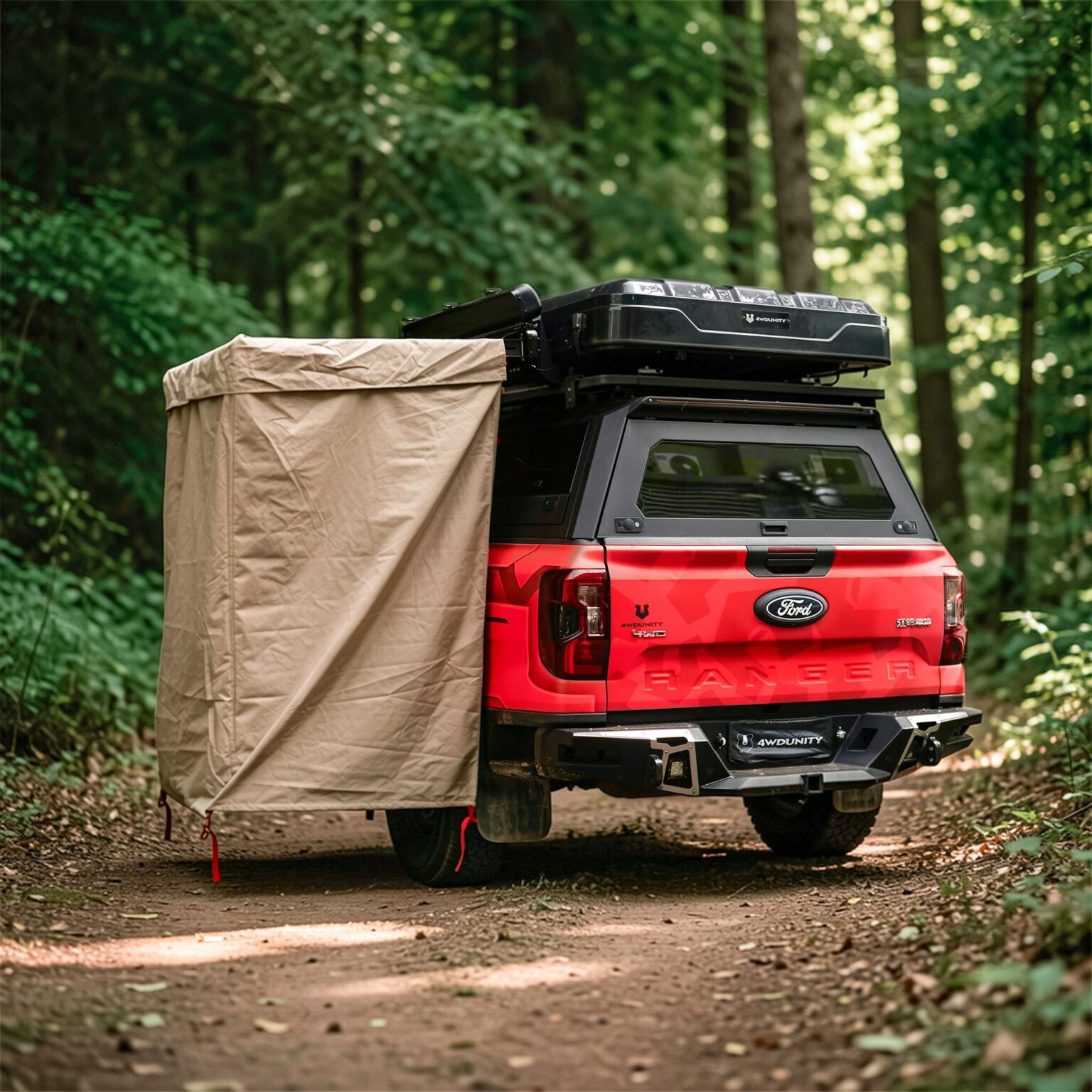
A camping shower setup fails for boring reasons — ground, water and drainage. A shower at camp is not a luxury item — it changes how a trip feels by day three. But most camp shower setups fail for one of three boring reasons: the ground was not chosen for drainage, the water was never going to be warm enough, or the enclosure was pitched in the wind without anchors. This is the whole system, from site selection to grey water.
The variables are water volume, water temperature, and where the dirty water goes. Solve those three and the enclosure itself is the easy part.
Camping shower setup: the water budget
| Use | Per person per day | Notes |
|---|---|---|
| Drinking | 2.0–3.0 L | More in heat or at altitude |
| Cooking and cleaning up | 1.0–1.5 L | Less with one-pot meals |
| Washing hands and face | 0.5 L | Spray bottle method uses a quarter of a basin |
| Full shower | 4.0–6.0 L | 5 L is a comfortable 3-minute shower with a trigger nozzle |
| Hair wash (occasional) | 2.0 L extra | — |
A couple showering every second day for ten days needs roughly 30 L of shower water plus 70 L of general use. That is 100 L, which is 100 kg — the heaviest single category of consumable you will carry. Plan the tank or jerry can capacity around this number, and plan where it sits (low, between the axles).
Heating water without a plumbed site
| Method | Output | Heat-up time | Best for |
|---|---|---|---|
| Solar bag (20 L, black) | ~10 L of warm water | 2–3 h in direct sun to reach 35–40 °C | Warm climates, basecamp, zero fuel |
| Kettle method | 5–8 L per kettle cycle | 8–10 min per 2 L on gas | Small volumes, cold weather, no extra kit |
| 12 V pump + heat exchanger (engine coolant) | Continuous, 4–6 L/min | 5 min after engine start | Vehicle-based systems, groups |
| Gas instant heater | 4–6 L/min | Immediate | Long trips, families, but needs ventilation planning |
| Immersion 12 V element | 10–20 L | 45–70 min, high current draw | Overnight heating in a jerry can — plan the amp hours |
For most travellers, the solar bag plus a kettle of hot water to top it up is the cheapest and most reliable combination. Mix 2 L of near-boiling water into 8 L of ambient water and you get 10 L at roughly 38 °C.
Site selection, in priority order
- Level ground. A slope makes the enclosure lean, the water run one way, and the floor slippery.
- At least 50 m from any watercourse, and downhill of it. This is a Leave No Trace principle and, in many parks, a regulation.
- Downwind of sleeping and cooking areas. Soap spray and steam drift further than you expect.
- Not visible from the track or neighbouring sites. A 1.9 m enclosure is not fully private from a raised viewpoint.
- Ground that will absorb water. Sand or soil, not rock or clay.
Managing grey water
This is the part most setups get wrong. Soapy water poured straight onto the ground kills vegetation and, near water, adds nutrients that cause algal growth.
- Use a collapsible basin or a 10 L bucket under the enclosure floor and empty it into a dug sump 30 m from water, strained through a cloth to catch food and hair.
- Use biodegradable soap — it still needs soil contact to break down, so never pour it into a stream.
- Strain and pack out solids. Hair and food scraps do not decompose in a week.
- If you are in a national park with a designated washing point, use it, even if it is inconvenient.
Pitching the enclosure so it stays up
A 1.1 × 1.1 × 1.9 m enclosure has a large sail area for its footprint. The sequence matters:
- Peg the four base corners first, on a taut base, before raising the frame. A twisted base makes the walls wrinkle permanently.
- Assemble the poles from the bottom up, feeding the fabric progressively. Do not push poles through a collapsed tent.
- Attach the roof last, then tension the walls downward.
- In wind, add one guy line from the top corner facing the prevailing wind before you finish tensioning. One line is usually enough if the base is well pegged.
- Zip the door closed before you walk away — an open enclosure in wind fills like a parachute.
Inside the enclosure: the small things that matter
- Floor. A mesh or perforated rubber mat keeps feet off mud and lets water drain. Bare fabric floors get slippery with soap.
- Hanging point. A loop at the top centre for a dry bag or a small LED light, plus a mesh pocket for soap and shampoo.
- Ventilation. A high vent stops steam condensing on the ceiling and dripping back onto you.
- Trigger nozzle. The single biggest water saver — it turns a 12 L shower into a 5 L shower.
Cold-weather showering
Below about 10 °C, the limiting factor is not water temperature but exposure. Practical adaptations: pre-heat the enclosure with a lantern or a hot water bottle five minutes before use, keep a dry towel inside the enclosure, and shower in the middle of the day rather than the evening. A 12 V pump with a long hose lets you keep the water container inside the vehicle, where it stays warmer.
Our shower room range is built around a 1.1 m square footprint with a 1.9 m peak and a mesh base, and the OEM team can specify fabric weight and frame section for your climate if you are buying for a dealership.
Related guides: Overlanding 12V power sizing · Camping water filtration and storage