
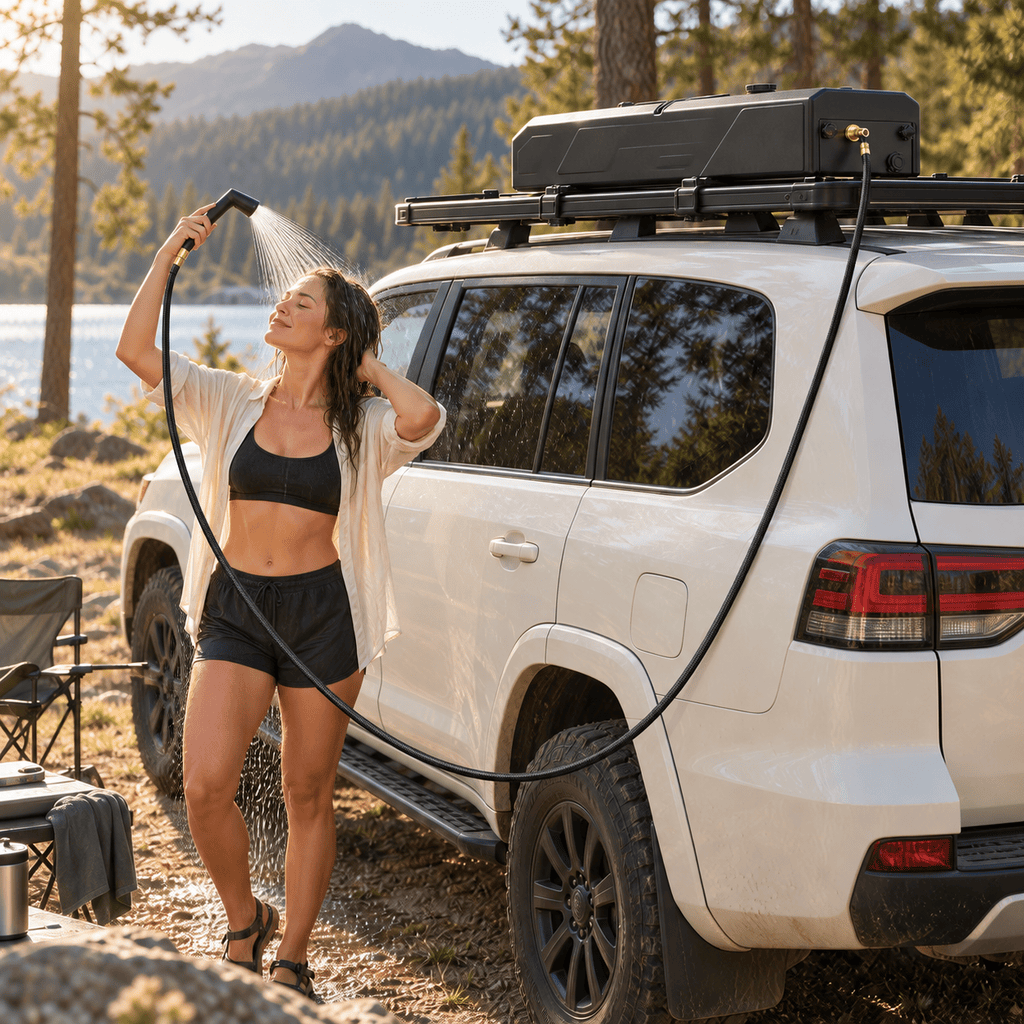
Camping water filtration and storage is the one supply you cannot improvise — water is the heaviest thing most overlanders carry. A two-person, seven-day remote trip needs 70 litres, which is 70 kg sitting somewhere in or on the vehicle. Getting the volume, the container and the treatment right is a packaging problem before it is a survival problem.
Start with consumption, then decide storage, then decide treatment. Doing it in the other order produces either a tank you cannot fill or a filter that cannot keep up.
Camping water filtration: how much water you actually need
| Use | Per person per day |
|---|---|
| Drinking | 2.0–3.0 L (more above 35 °C or 2,000 m) |
| Cooking and dish rinse | 1.0–1.5 L |
| Face, hands, teeth | 0.5 L |
| Shower every second day | 2.5 L averaged |
| Reserve (breakdown, spillage, a stranded night) | +20% on total |
Plan 5 L per person per day as a working figure for a comfortable trip, or 3.5 L/day if you are rationing. Two people, seven days, comfortable: 70 L. Add a 20% reserve and you are at 84 L, which is why most touring setups carry 80–100 L in combination.
Container types and where they go
| Type | Capacity | Advantages | Watch out for |
|---|---|---|---|
| Jerry cans (food-grade HDPE) | 10–20 L each | Modular, easy to carry, cheap to replace, visible level | Need a tap or a pump; heavy when full at 20 kg |
| Built-in tank | 40–80 L | Low centre of gravity, plumbed tap | Hard to clean; can grow algae if left full in sun |
| Bladder tank | 30–60 L | Fits odd shapes, packs flat when empty | Punctures; taste transfer if not dried |
| Bottles (1–2 L) | — | Drinking water separated from washing water | Single-use plastic degrades and leaches in heat |
The best arrangement for most vehicles is a hybrid: a 40–60 L tank low and forward for washing and cooking, plus 20–40 L in jerry cans for drinking water, so a contaminated tank does not leave you with nothing to drink.
Weight placement matters more than total capacity. Water at 1 kg/L is the densest thing you carry apart from the battery and the fridge. Keep it between the axles, as low as possible, and never on the roof — 40 kg on the roof is worse for handling than 120 kg in the boot floor.
Keeping stored water drinkable
- Fill from a treated source (municipal supply) whenever you can. It is already chlorinated and will keep for weeks in a clean container.
- Pre-treat tank water with chlorine dioxide or a chlorine tablet dose at fill time if the source is uncertain, then filter at the point of use.
- Keep containers out of direct sun. UV and warmth grow algae on the tank walls within a week.
- Empty and dry tanks between trips. A tank left half full in a warm vehicle for a month develops a biofilm that no filter will fix.
- Sanitise at the start of each season: 1 teaspoon of unscented household bleach per 4 L of water, fill, leave 4 hours, drain, rinse twice. For a 60 L tank that is roughly 15 ml of bleach.
Filtration: know what each stage removes
| Technology | Removes | Does not remove | Flow rate |
|---|---|---|---|
| Hollow-fibre 0.1–0.2 µm | Bacteria, protozoa, cysts, sediment | Viruses, dissolved chemicals | 1–3 L/min (gravity), 2–4 L/min (pump) |
| Ceramic gravity filter | Bacteria, protozoa, sediment | Viruses, chemicals | 0.3–1 L/h (slow) |
| Activated carbon block | Chlorine, taste, odour, some chemicals | Pathogens on its own | 1–2 L/min |
| UV purifier | Viruses, bacteria (needs clear water) | Sediment, chemicals; needs power | 1 L/min |
| Reverse osmosis (portable) | Almost everything including salt | — | 0.1–0.3 L/min, needs high pressure |
For most overland travel, a 0.1 µm hollow-fibre filter plus a carbon stage is the right answer: it handles bacteria and protozoa, the carbon fixes taste, and it needs no power. Add chlorine dioxide tablets as a virus barrier if you are drawing from surface water in a populated region.
Boiling and chemical treatment
- Boiling at a rolling boil for 1 minute (3 minutes above 2,000 m) kills all pathogens. It does nothing for taste or sediment, and it uses fuel — roughly 8 minutes of gas per litre from cold.
- Chlorine dioxide — 4 hours contact time, effective against viruses and cysts, and the taste is more acceptable than plain chlorine. It is the best backup treatment.
- Iodine — effective but tastes bad, stains, and is not suitable for pregnant women or people with thyroid conditions.
- Never rely on a single method for surface water. Filter for clarity and pathogens, then treat chemically for viruses.
Field routine that keeps everyone healthy
- Two containers, always: “drinking” and “utility”, clearly marked. Never cross-fill.
- Fill drinking water at the last known-good source, not the most convenient one.
- Filter at the point of use, not at fill time — filtered water has no residual protection.
- Wash hands before handling the drinking container, every time. Most waterborne illness on trips is hand-to-mouth, not from the water itself.
- Log the fill date on a strip of tape on the container. Water older than 30 days gets used for washing, not drinking.
Winter and altitude notes
Water freezes, and containers split when it does. Leave 10% headspace in every container, keep at least one 2 L bottle inside the cab, and melt snow rather than ice if you must — snow has more air and wastes fuel. At altitude, consumption rises by roughly 1 L per person per day, and boiling point drops, so extend boiling times.
Our camping equipment range includes water storage and pump accessories designed to sit in a drawer system rather than on the roof, and the OEM team can quote container sets to your market’s volume.
Related guides: Overlanding 12V power sizing · Camping shower setup