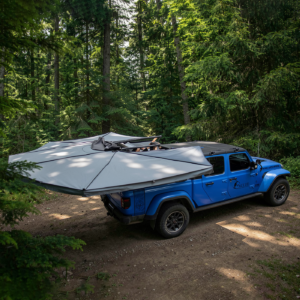
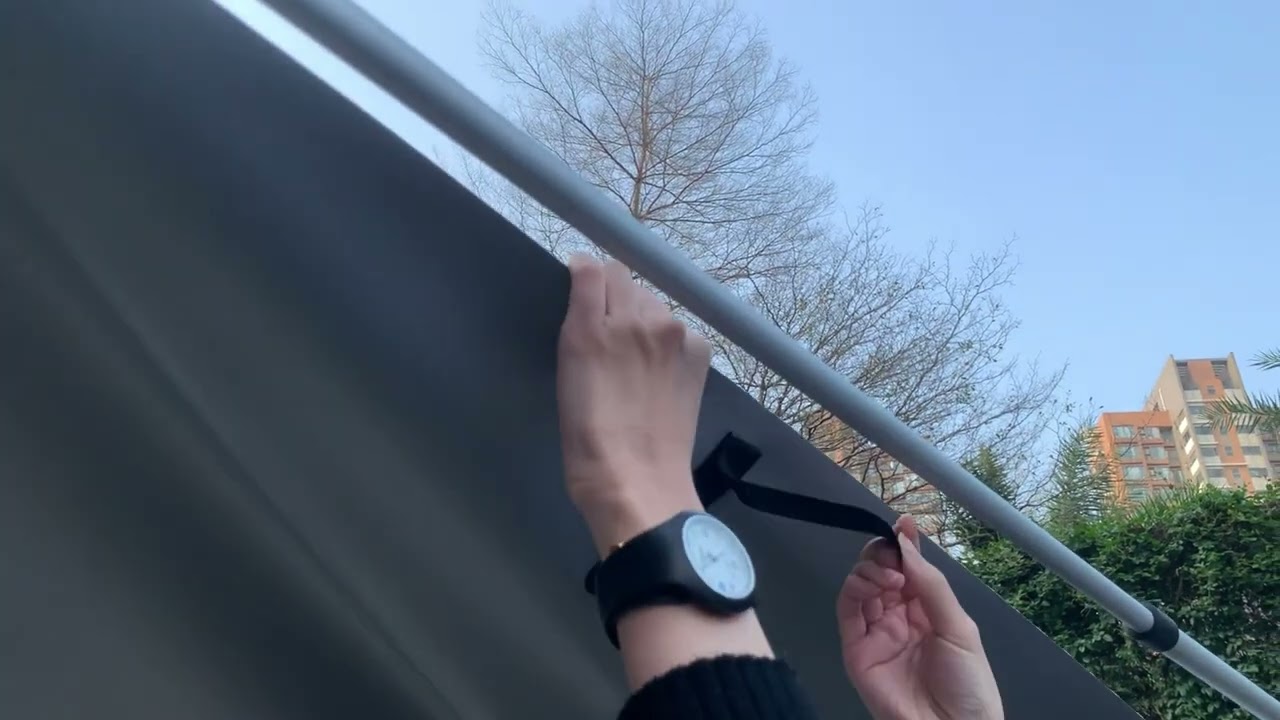
180 vs 270 awning decides how much camp you get: a 180° covers one side of the vehicle, a 270° wraps two. On paper the 270° wins on coverage, and in practice it also adds 10 kg, a second mounting bracket, and a deployment routine that has to be done in the right order. Here is the decision made on real numbers rather than marketing photos.
The choice is less about coverage than about how you camp. A vehicle that moves every day wants the awning that goes up in 90 seconds and comes down wet without drama. A vehicle that sits for four nights wants the one that turns the side of the truck into a room.
180 vs 270 awning: coverage, measured properly
| 180° awning (2.5 m) | 270° awning (2.5 m arm) | |
|---|---|---|
| Deployed area | 5.0–6.5 m² | 8.5–11.0 m² |
| Coverage arc | One side, ~180° | Side plus rear corner, ~270° |
| Shaded footprint | 2.5 × 2.2 m | Up to 6 m along the vehicle × 2.5 m out |
| Unit weight | 9–16 kg | 19–28 kg |
| Packed length | 2.1–2.6 m | 2.4–2.7 m |
| Mounting brackets | 2 | 2–3 plus a rear support |
| Solo deployment | 60–120 s | 60–90 s (with legs) / 3 min (with guy lines) |
| Wind vulnerability | Moderate | High — much larger sail area |
Those area figures are the ones that matter, not the “180°” or “270°” label. A 2.0 m 180° awning gives you about 4 m²; a 2.5 m gives 6 m². Always ask for the deployed area in square metres, plus the projection distance from the vehicle — that second number tells you whether two chairs and a table actually fit.
Where the 270° genuinely wins
- Rain. A 270° awning wrapped around the rear corner keeps rain off the tailgate, which is where most people cook and where the drawer system opens. With a 180° you end up moving the kitchen under the awning or getting wet.
- Sun angle. Because it wraps, it keeps blocking sun as the day rotates. A 180° becomes useless at about 4 pm if you mounted it facing east.
- Basecamp. Four nights in one spot, with a table, chairs, a fridge slide and a shower cube — the extra 4 m² changes how the camp works.
- Annex compatibility. Most 270° awnings accept a wall kit that converts them into an enclosed room. A 180° with a wall kit becomes a corridor.
Where the 180° wins
- Weight and balance. A 270° awning is 20–28 kg hanging off one side of the roof, cantilevered. On a vehicle already carrying a roof top tent, that is a meaningful addition to the outermost load bar.
- Deployment speed in wind. A 270° has to be unrolled and its legs deployed in a specific sequence; in gusty conditions, one person cannot hold it while the other pegs. A 180° can be rolled up by one person in 20 seconds if a gust hits.
- Narrow tracks. A deployed 270° projects up to 3.5 m from the vehicle. On a tight campsite or a busy caravan park, that is often too much.
- Cost of a mistake. If a 180° gets bent, replacing an arm is a straightforward part. A bent 270° arm often means a new arm assembly.
- Looking after it wet. Both must be dried before storage. A 180° is simply easier to handle alone.
Mounting height and door clearance
The awning housing must sit above the door line, ideally with 15–30 mm clearance to the roof or rack, and the leading edge should not overhang the windscreen or the rear door. Two practical checks before you buy:
- Measure from the top of the open door to the rack underside. If it is under 20 mm, a 270° housing will not fit without spacers, and spacers on a cantilevered load are a bad idea.
- Check which side you want it on. Right-hand side suits right-hand-drive vehicles parked on the left of a road, and keeps the awning off the traffic side in most countries.
Water management
Neither awning sheds water on its own if it is pitched flat. Water pools in the middle, stretches the fabric, and eventually finds a seam.
- Set the outer edge 100–150 mm lower than the vehicle edge. That is enough to run water off without making the awning a wall.
- On a 270°, also drop one corner by an extra 50 mm so water cannot travel around the wrap and pool at the rear.
- Never leave either awning deployed in rain without the legs down and pegged. The load of pooled water on a 6 m² awning is measured in hundreds of kilograms.
A decision rule that holds up in practice
- Move daily, 2 people, one vehicle: 2.5 m 180° awning. Fast, light, repairable, and enough shade for two chairs and a stove.
- Basecamp trips, family, cooking at the tailgate: 270°. The wrap-around coverage is worth the weight and the deployment routine.
- Both: a 180° on the side and a separate rear awning or a quick-deploy tarp off the tailgate gives you most of the 270° benefit at two-thirds of the weight, if you do not mind two pieces of kit.
What to inspect on any awning
Three things decide whether an awning lasts five seasons: the arm hinges (should be riveted or bolted, not pressed), the fabric weight (280 gsm minimum for a 2.5 m awning, or it will flap and stretch), and whether the mounting brackets are 3 mm steel or 1.5 mm folded sheet. The last one is where cheap awnings fail on corrugations.
Our awning range includes both 180° and 270° configurations built to these specifications, and the OEM team can advise on arm length, fabric and bracket design for your market.
Related guides: How to guy out an awning · Canvas care and mould prevention